SONAR
Seeing with sound
Active sonar sends a pulse into the water. The time between the pulse and its echo gives the range of whatever it bounced off.
Time an echo sonicdoodle
Start
HOW ECHOES WORK
An echo is a measuring tape made of sound.

Ships and bats use the same trick. Send out a pulse of sound, time how long the echo takes to come back, and you know how far away something is. Ocean scientists map the seabed this way, and bats hunt insects in the dark.
THEREand back again
Time an echoKeep in mind
THE SHORT ANSWER
The method is the same in water and in air.
Only the speed of sound changes.
SONAR
Active sonar sends a pulse into the water. The time between the pulse and its echo gives the range of whatever it bounced off.
Time an echoBATS
Bats send out short, loud, high-frequency pulses from their mouths or noses and use the returning echoes to map their surroundings.
Bat callsLISTENING
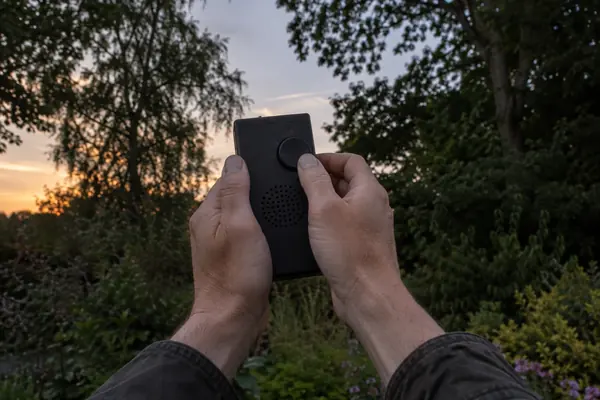
A bat detector converts ultrasonic calls into sounds people can hear, so walkers can tell some species apart by their calls.
How to listenA QUICK ECHO CHECK
Pick an echo time to see how far away the object is. The sound has to go there and back, so the distance is half the total trip. The bar shows how far.
Worked out from NOAA's round figures for the speed of sound: about 340 metres a second in air and 1,500 in seawater. Real speeds vary with temperature and pressure.
TWO NUMBERS WORTH KNOWING
One figure for the sea,
one for the bats in a British garden.
4× faster
How much faster sound travels in seawater than air
NOAA gives about 1,500 metres a second in seawater against about 340 in air: generally over four times faster. Low sounds can travel hundreds of kilometres underwater.
SPEED · NOAA
≈ 110 kHz
Peak frequency of the lesser horseshoe bat
The greater horseshoe bat calls at just above 80 kHz. Common, soprano and Nathusius' pipistrelles are best heard at about 45, 55 and 35 kHz.
BAT CALLS · BCN WILDLIFE TRUST
Most British bats make very brief calls, usually under 10 milliseconds, in rapid series of up to 25 a second. Horseshoe bats instead give long whistles of up to 50 milliseconds or more at a near constant frequency.
LISTENING FOR BATS
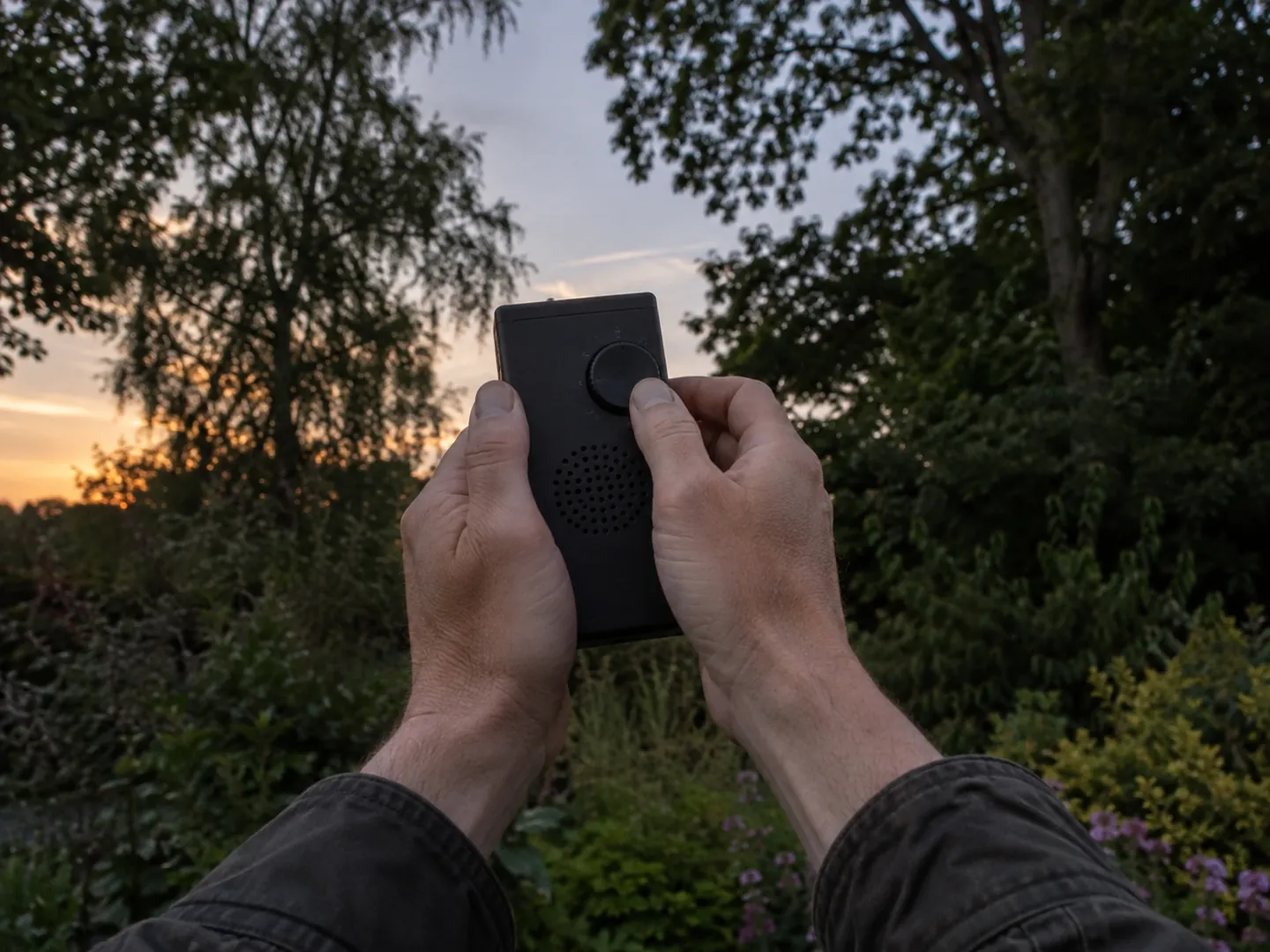
UK bat groups describe the basics of using a bat detector. Some ways to get started:
Step 1
London Bat Group calls these affordable detectors perfect for beginners. You tune them to one frequency at a time.
Step 2
Pipistrelles are usually the first bats you meet, and are usually listened for with the detector set to 50 kHz.
Step 3
Pipistrelles sound like irregular smacks. A feeding buzz, like someone blowing a raspberry, means a bat is closing on prey.
Step 4
The group suggests going on a few bat walks with experienced people and trying their detectors before you buy one.
ACTIVE AND PASSIVE

Active sonar sends out its own pulse and listens for the echo, which tells it the range and direction of an object. NOAA uses it to make nautical charts, find hazards, search for shipwrecks and map the seafloor.
Passive sonar sends nothing. It only listens for sounds such as ships or whales. One passive listener cannot measure range, but several together can locate a sound source from the time delays between them.
Questions
Sound Navigation and Ranging. NOAA explains that sonar is useful at sea because sound waves travel farther in water than radar and light waves do.
Multiply the speed of sound by the time the echo took, then halve it, because the sound travelled out and back. In seawater that is about 750 metres for a one-second echo.
No. London Bat Group notes that bats can see very well, probably better than we do at dusk, but they also use echolocation to move and hunt in the dark.
Sometimes. The frequency and type of call help, but the BCN Wildlife Trust key warns that accurate identification from calls alone is not always possible.
NOAA says temperature and pressure bend sound into a sound channel in the deep ocean, letting it travel thousands of miles without losing much energy.
Destination
Updated
ABOUT THIS NAME
sonicdoodle.com is part of the DoodleSale portfolio. It isn't in an auction right now, but you can ask about leasing it.